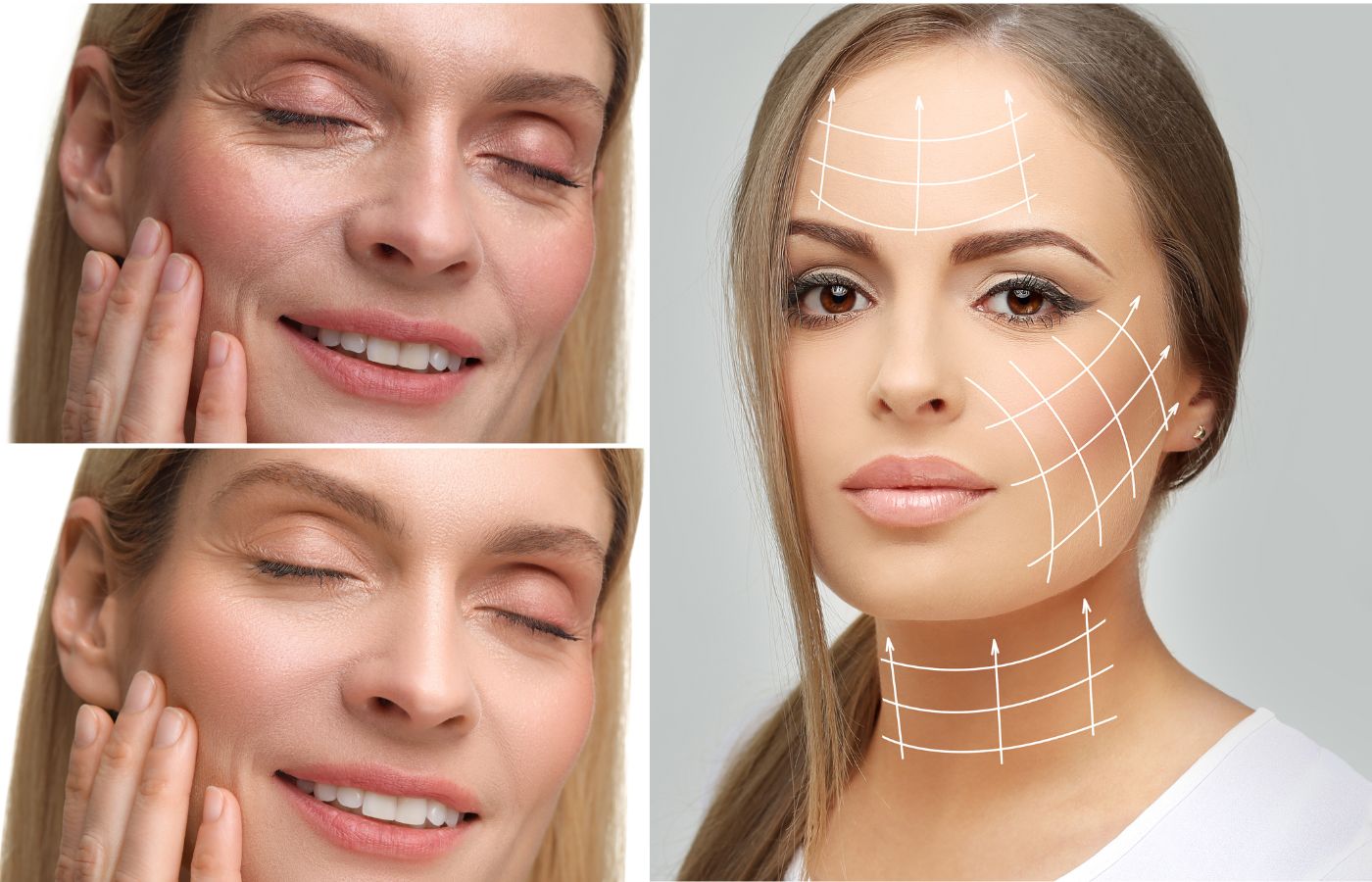
What you're seeing
Foundation catches on uneven patches. Skin feels rough to the touch.
Under certain lighting — particularly side lighting or direct flash — the skin surface reads as irregular, bumpy, or visibly pored. Foundation and concealer settle into texture rather than sitting on top of it. The skin does not feel smooth under fingertips. Hydration improves the feeling temporarily but the irregularity returns within hours.
Rough texture is a surface problem with a below-surface cause. The irregularity is structural — it reflects a renewal cycle that has slowed, an extracellular matrix that has thinned, and often a subclinical inflammatory state that is disrupting the orderly shedding of old surface cells.
The biology
Three mechanisms producing the same surface result
Slowed keratinocyte turnover
As cell renewal slows, surface cells remain in place longer. They accumulate in irregular patterns — thicker in some areas, thinner in others — producing the uneven texture visible in photographs and felt under touch.
Subclinical inflammation
Low-grade chronic inflammation disrupts the orderly desquamation process. Cells that should shed are retained, and new cells are produced in a disorganized pattern. The result is visible as both congestion and uneven surface architecture.
Extracellular matrix depletion
The ECM beneath the epidermis provides the structural foundation that gives skin its smooth, taut appearance. As collagen and hyaluronic acid decline, the surface loses its underlying support — allowing the texture of accumulated dead cells above to become more pronounced.
What the skin needs
Restore the renewal cycle — not just remove the accumulated surface.
Exfoliation removes the accumulated surface cells and produces temporary smoothing. It does not restore the rate at which new cells are produced. The texture returns because the renewal cycle that keeps the surface consistently fresh has not been addressed.
EGF class oligopeptides (sh-Oligopeptide-1) support keratinocyte proliferation at the basal layer — the foundation of the renewal cycle. By activating the machinery that produces new cells, they restore the consistent turnover that exfoliation mimics at the surface. The improvement is slower to appear than exfoliation but more durable because it addresses the process, not the accumulation.
Common questions
What causes rough skin texture?+
Rough skin texture is caused by slowed keratinocyte turnover, accumulated dead surface cells, subclinical inflammation, and depleted extracellular matrix. The surface irregularity is physically real because dead cell accumulation is structurally uneven.
Why does my skin feel bumpy but I don't have acne?+
Bumpy skin without active breakouts is usually comedonal congestion, keratosis pilaris, or textural irregularity from subclinical chronic inflammation. Each has a different mechanism and responds to different approaches.
Can skin texture be permanently improved?+
Yes, when the approach addresses renewal rate rather than just surface removal. Exfoliation produces temporary smoothing. Compounds that support keratinocyte proliferation restore the ongoing cycle that keeps the surface consistently renewed.
What ingredients improve skin texture?+
EGF class oligopeptides support keratinocyte proliferation — restoring the rate at which new surface is produced. Unlike exfoliants, which remove what is present, they produce durable rather than temporary improvement.
The Renewal Protocol
EGF Oligopeptide. 6 powder-mix droppers. Supports keratinocyte proliferation and surface renewal from below — addressing the cycle that rough texture reflects, not just the surface it produces.