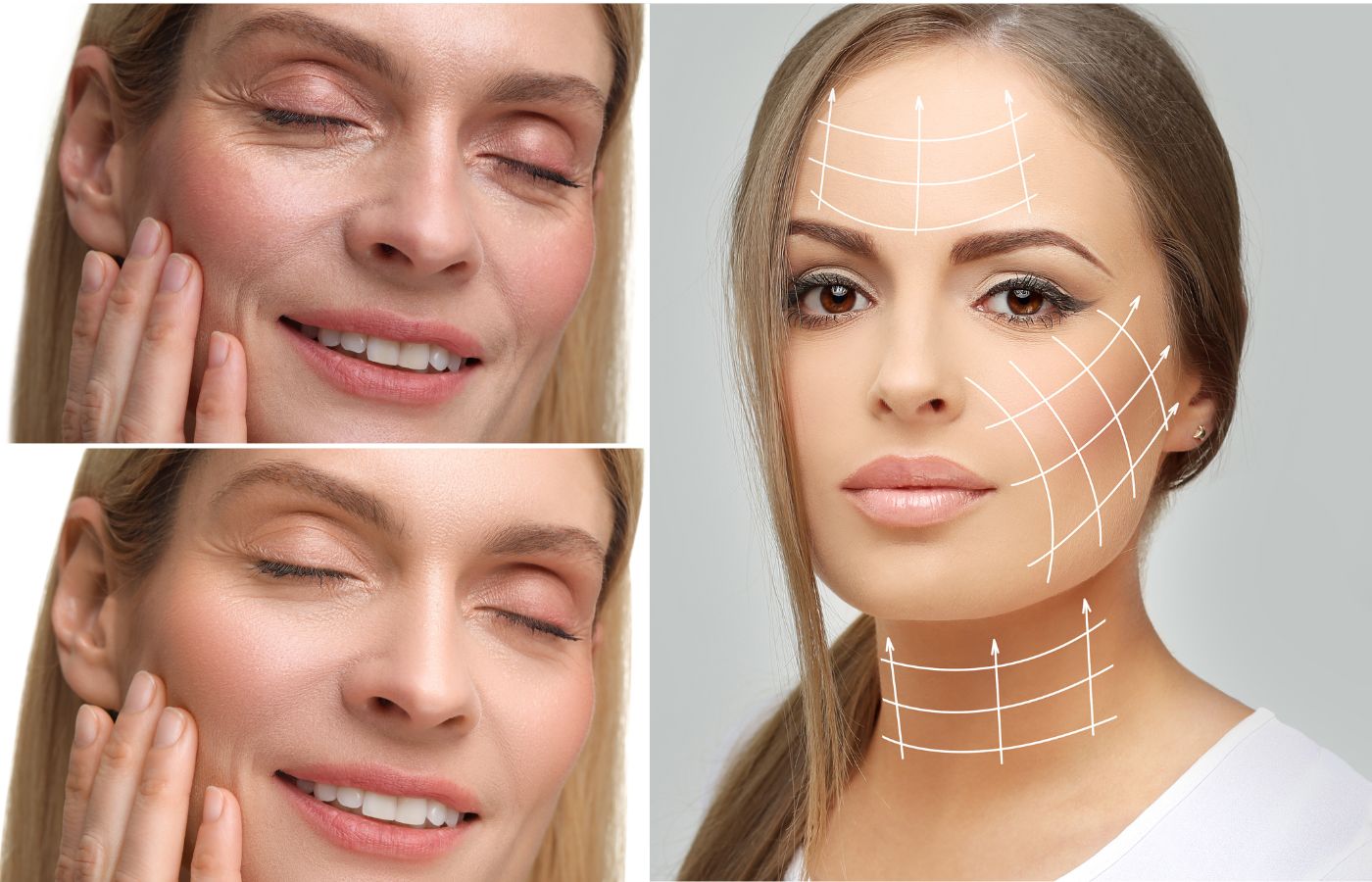
What you're seeing
Lines that weren't there last year. Creases that stay after the expression is gone.
Fine lines appear first around the eyes, across the forehead, and at the corners of the mouth — places where skin moves most frequently. Initially they are visible only during expression. As they deepen into static wrinkles they are present at rest, independent of movement.
The difference between a fine line and a wrinkle is not cosmetic — it is structural. Fine lines reflect surface changes; wrinkles reflect the loss of dermal architecture beneath the surface. Treating both the same way produces partial results at best.
The biology
Collagen declines. The dermis thins. Lines become permanent.
The dermis is held together by a matrix of collagen fibers — the structural scaffolding that gives skin its density and its ability to rebound after movement. Collagen production declines approximately 1–1.5% annually beginning in the mid-20s. Simultaneously, matrix metalloproteinases (MMPs) — enzymes that break down existing collagen — become more active with UV exposure, inflammation, and age.
When the dermis thins enough that skin can no longer spring back after a repeated fold or crease, a dynamic wrinkle becomes static. At this point, no surface product reaches the source of the problem — the depleted collagen matrix two to three millimeters below the surface.
What the skin needs
Signal fibroblasts to produce what the dermis has stopped making.
GHK-Cu signals fibroblasts to produce collagen, elastin, and glycosaminoglycans — the structural components of the dermis that collagen loss has depleted. It simultaneously downregulates the matrix metalloproteinases that are accelerating the breakdown. The dual action shifts the balance from net loss toward net restoration.
The mechanism is restorative rather than additive — GHK-Cu activates the skin's own production machinery rather than filling the deficit with applied material. Changes are incremental and build over successive quarterly cycles. Early intervention — before the dermal deficit is significant — produces better outcomes than delayed treatment.
Common questions
What causes fine lines and wrinkles?+
Fine lines form where dermal collagen and elastin have thinned enough that skin can no longer return to its original position after repeated facial movement. Wrinkles deepen as collagen continues to decline and the dermis loses structural volume — driven by the 1–1.5% annual collagen loss that begins in the mid-20s.
What is the difference between fine lines and wrinkles?+
Fine lines are superficial — they form at the skin surface where hydration and cell turnover have slowed. Wrinkles are structural — they reflect loss of dermal volume and collagen scaffolding beneath the surface. Different causes require different approaches.
Can you reverse wrinkles without injections?+
Deep wrinkles caused by significant volume loss are best addressed with filler. Fine lines and early wrinkles caused by collagen decline can be meaningfully improved with compounds that restore fibroblast activity. GHK-Cu works through this mechanism, documented across six decades of published research.
What age do wrinkles start forming?+
Fine lines typically appear in the late 20s to early 30s. Static wrinkles visible at rest typically develop in the 40s when collagen breakdown has significantly outpaced production for several years.
The Structure Protocol
GHK-Cu Complex. 12-vial quarterly system. Signals fibroblasts to produce collagen and downregulate the enzymes that accelerate its breakdown — addressing fine lines and wrinkles at their structural source.